Weldable membrane for basements: pre-applied TPO, welded laps
A weldable membrane for basements is a sheet whose laps are joined by heat welding rather than by adhesive, so the seams become part of one continuous sheet. Keshun Aquaprufe APF-D110 combines this with a pre-applied design: the membrane is laid on the blinding concrete before the base slab is cast, and the structural concrete bonds to it.
How a pre-applied TPO membrane works
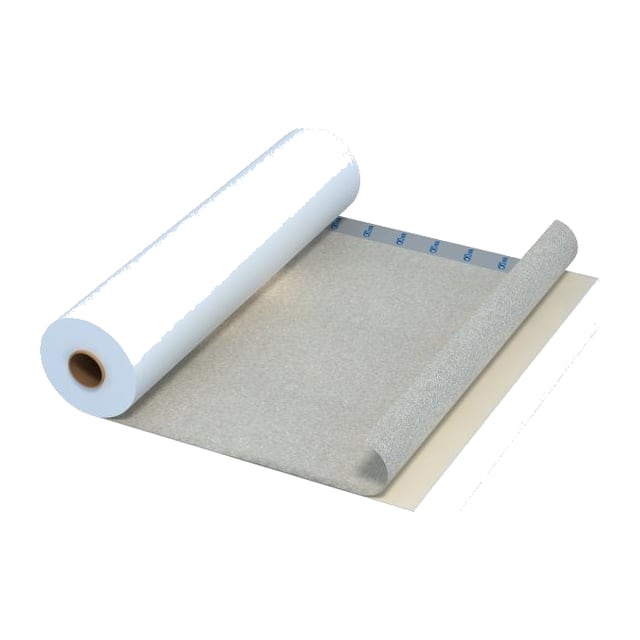
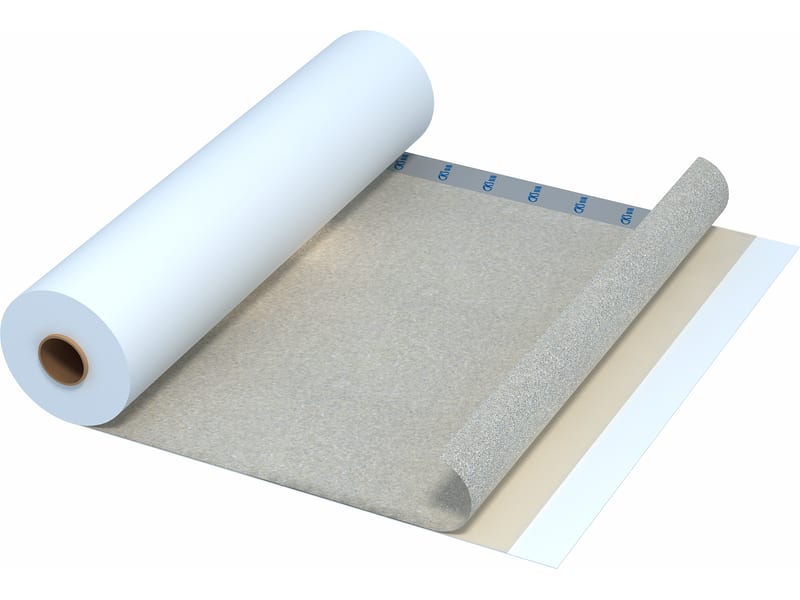
APF-D110 has three layers: a TPO sheet resistant to heat ageing, UV and chemical attack; a butyl self-adhesive layer that is water- and air-tight; and a particulate layer facing up. The fresh concrete bonds to the particulate layer, which prevents lateral water migration between the membrane and the structure, the main weakness of loose-laid or post-applied sheets. According to Keshun, the butyl layer also self-seals small punctures of up to 2 mm, and the membrane is trafficable immediately, with no protection screed needed before fixing reinforcement.
Why welded laps
On self-adhesive membranes the laps rely on adhesive. On APF-D110 the long laps (80 mm) are hot-air welded, usually with an automatic welder, and every weld can be probed along its full length; defects are re-welded immediately. Keshun’s own comparison with its pre-applied HDPE membrane APF-C notes that welded laps have higher peel strength and do not delaminate under immersion, and that the softer TPO sheet is easier to detail at corners and edges. In deep basements, where water pressure on the laps is highest, this is the main reason to choose a welded system.
Data sheet values (Keshun, Rev. 2024)
| Property | Value | Test method |
|---|---|---|
| Tensile strength | 15 MPa | ASTM D412, Method A |
| Elongation at break | 500 % | ASTM D412, Method A |
| Peel strength | 1.8 N/mm | ASTM D903 |
| Puncture resistance | 350 N | ASTM E154, section 10 |
| Tear strength | 60 N/mm | ASTM D624 |
| Low-temperature flexibility | −29 °C, no cracks | ASTM D1970, section 7.6 |
| Water vapour transmission | < 0.02 g/(m²·h) | ASTM E96 |
Rolls are 20 m × 1 m, 1.5 mm or 1.7 mm thick. System components: TPO H-type overlap tape for welding and KS-501 sealant. Shelf life is 12 months; store at 5–45 °C, upright in a single layer, away from sun and rain.
Installation sequence
- Substrate: blinding concrete clean, dry and even, with no mortar lumps or sharp objects. Brush Keshun KS-101 crystalline slurry around each pile head, 500 mm wide.
- Set-out: snap chalk lines for the sheet positions.
- Details first: internal corners, pile caps and upstands, using double-sided tape, sand-faced tape and figure-eight patches 60–80 mm wide at the corners.
- Vertical faces: long laps of 80 mm, hot-air welded; the bottom edge of the wall sheet is turned 350 mm onto the slab and butt-jointed to the horizontal sheet.
- Large areas: stagger the short edges of adjacent sheets by at least 500 mm; weld the 80 mm long laps with an automatic welder, then cover the weld with sand-faced tape so the lap bonds to the concrete like the rest of the sheet.
- End laps: butt the short edges over a 150 mm wide homogeneous TPO strip and hot-air weld each edge to the strip.
- Pile heads: apply KS-501 sealant 100 mm wide around the pile to close the joint between membrane and pile.
- Repairs: scratched granules are covered with sand-faced tape; a puncture is cut back 30–50 mm, an 80 mm homogeneous TPO disc is placed underneath and hot-air welded, then covered with sand-faced tape.
- Reinforcement and concrete: fix the reinforcement and pour the base slab directly on the membrane; protect waiting lap edges with blocks.
Clean and dry the lap edges before welding and make a trial weld at the start of every shift to set temperature and speed. VNA’s Vietnamese site video shows the full 13-step procedure.
APF-D110 or the HDPE membrane APF-C?
VNA’s standard waterproofing drawings use APF-C (self-adhesive laps, no welding) for basements of one to three levels, where it balances speed and cost; for basements deeper than three levels or with high groundwater pressure they specify APF-D110. Note the substrate difference: Keshun’s APF-D110 procedure calls for dry blinding, while APF-C can be laid on damp blinding with no standing water.
Where to buy in Vietnam
Keshun confirms VNA as a distributor in Vietnam (authorization letter, valid 1 April 2026 – 31 December 2028). Projects receive a quotation with the layer build-up, data sheets and test reports for submittals; goods ship with CO/CQ per batch. See the basement waterproofing sections or contact VNA.
APF-D110 product pageRequest a quotation
Figures from the Keshun Aquaprufe APF-D110 data sheet (Rev. 2024) and Keshun’s comparison of APF-D110 and APF-C; installation details from Keshun’s standard procedure as edited in VNA’s site video.