Tile adhesive classes C1, C2, T, E, S1, R2 explained
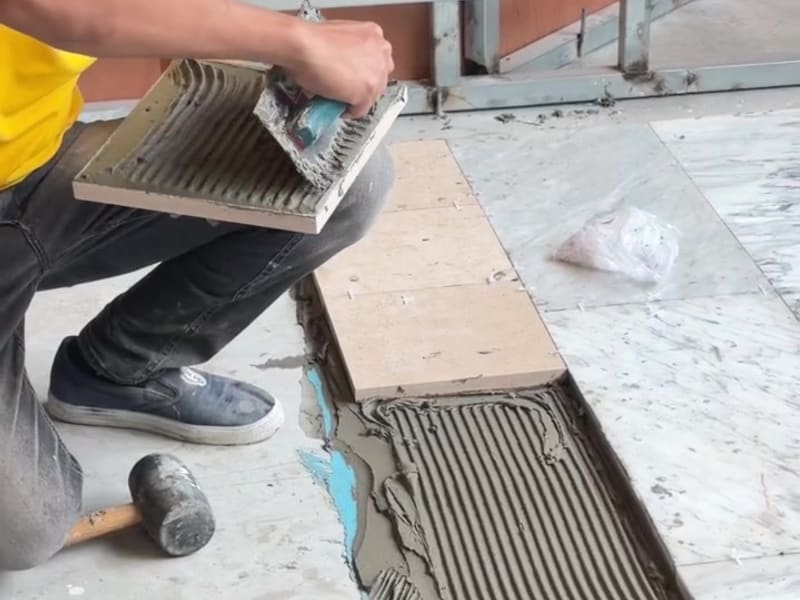
Tile adhesives are classified by ISO 13007-1, adopted in Vietnam as TCVN 7899-1:2008. The code on the bag, such as C1, C2TE or C2TES1, tells you the binder, the adhesion level and any extra properties, which is what you need to match the adhesive to the tile, the substrate and the location.
Reading the code
| Code | Meaning | Main requirement (ISO 13007-1 / TCVN 7899-1) |
|---|---|---|
| C | Cementitious adhesive (powder mixed with water) | Classes C1, C2 |
| D | Dispersion adhesive (ready-mixed paste) | Classes D1, D2 |
| R | Reaction resin adhesive, usually two-part epoxy | Classes R1, R2 |
| C1 | Normal cementitious adhesive | Tensile adhesion ≥ 0.5 N/mm² initially, after water immersion, after heat ageing and after freeze–thaw cycles |
| C2 | Improved cementitious adhesive | Tensile adhesion ≥ 1.0 N/mm² in the same tests |
| T | Reduced slip | Wall tiles slip no more than 0.5 mm |
| E | Extended open time | Still ≥ 0.5 N/mm² after at least 30 minutes (normal adhesives: 20 minutes) |
| F | Fast setting | Reaches adhesion early, for areas returned to service quickly |
| S1, S2 | Deformable, highly deformable | Transverse deformation from 2.5 mm to under 5 mm (S1); 5 mm or more (S2) |
| R2 | Improved reaction resin adhesive | Shear adhesion ≥ 2.0 N/mm² initially, after water immersion and after thermal shock |
So C2TE is an improved cementitious adhesive with reduced slip and extended open time, and C2TES1 adds S1 deformability for substrates that move. The letters T, E and S can be combined with C1 or C2; the digit decides the adhesion level.
Which class for which job
| Situation | Usual choice | Why |
|---|---|---|
| Ordinary ceramic tiles indoors on stable cement render | C1 (with T on walls) | Absorbent tiles bond well to cementitious adhesive; T stops wall tiles sliding |
| Low-absorption porcelain, tiles 60 × 60 cm and larger, tall wall cladding | C2, often C2TE | Dense tile backs need higher adhesion; E gives time to adjust large tiles |
| Exterior, balconies, roof terraces; moving or vibrating substrates | C2 with S1 (C2TES1), or an R2 epoxy | Temperature and moisture make tile and substrate move differently |
| Natural stone, mesh-backed stone | Back-coat with an R2 epoxy (Demex R600), then fix with C2 adhesive wet-on-wet | Blocks moisture and salts that stain the stone; epoxy bonds to the resin mesh |
| Difficult substrates: tiling over existing glazed tiles, metal, glass, fibre-cement board, OSB | Two-part epoxy, class R2 | Cementitious adhesive bonds poorly to smooth, non-absorbent surfaces |
This is the common selection practice; a project specification overrides it. Tile adhesive is a bonding layer, not waterproofing: wet areas still need a waterproofing layer on the concrete before tiling.
Adhesives supplied by VNA
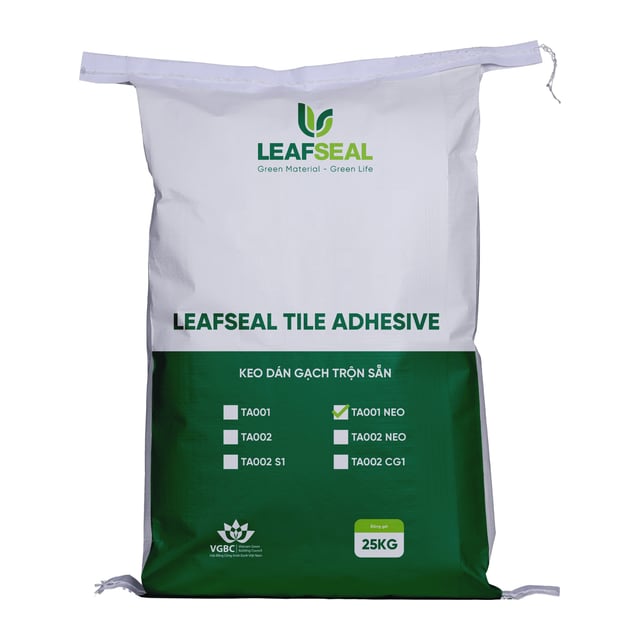
- LeafSeal cementitious tile adhesives, class C1: LeafSeal TA001 Neo for interior and exterior use. Adhesive strength ≥ 0.5 N/mm² at standard conditions, after water immersion and after heat ageing (TCVN 7899-2); for ceramic, granite and porcelain tiles up to 600 × 600 mm on walls and 800 × 800 mm on floors.
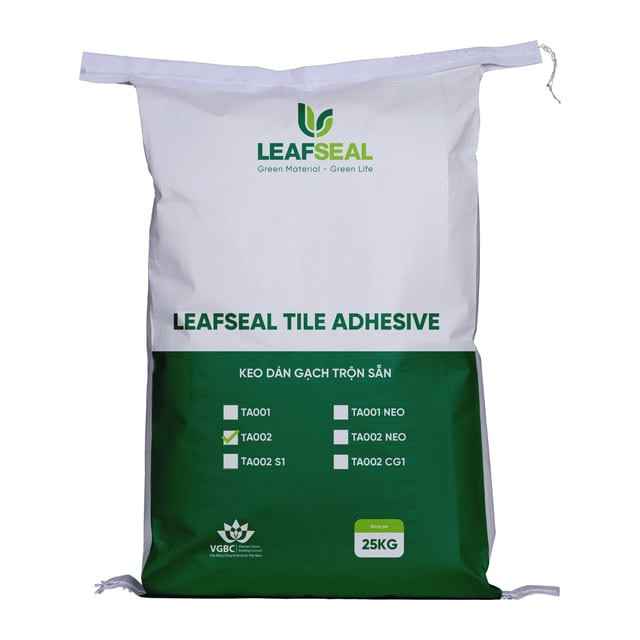
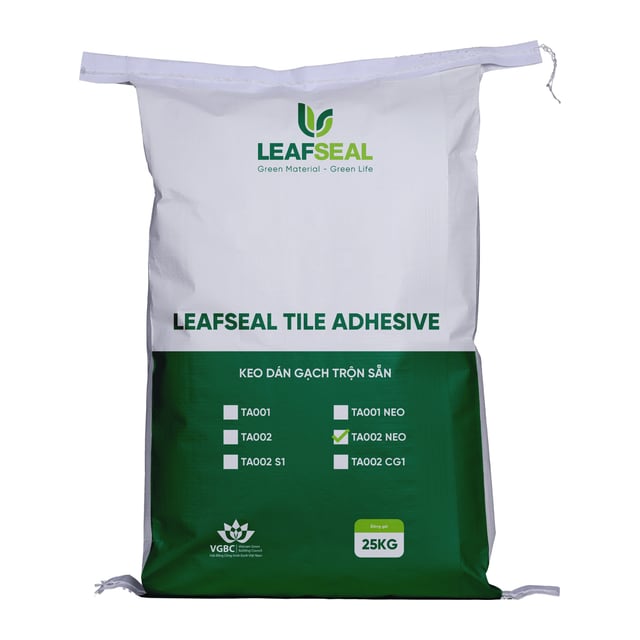
- LeafSeal cementitious tile adhesives, class C2, for large and ultra-large formats indoors and outdoors: LeafSeal TA002 (≥ 1.0 N/mm² at standard conditions and after water immersion, ≥ 0.5 N/mm² after heat treatment) and LeafSeal TA002 Neo (≥ 1.0 N/mm² in all three conditions).
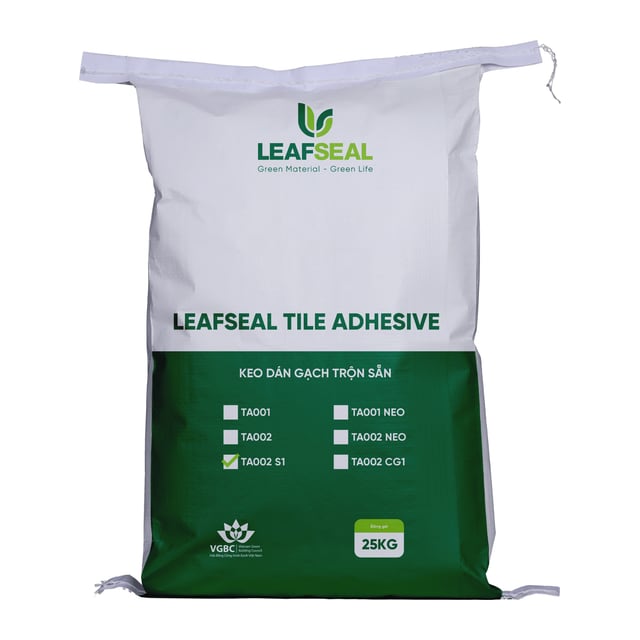
- LeafSeal TA002 S1, class C2 S1: ≥ 1.0 N/mm² in all three conditions and transverse deformation ≥ 2.5 mm, for surfaces subject to vibration or regular vehicle traffic, such as elevators, outdoor landscaping and cement board substrates.
- All five LeafSeal adhesives come in 25 kg bags and share the same working data: water/powder ratio 20–25 % by weight, open time ≥ 20 minutes, pot life 60 minutes, bed thickness 3–10 mm at about 1.4 kg/m² per mm, grouting after 24 hours. Their data sheets state no T, E or F designation. Joints are filled with the cementitious grouts LeafSeal TG020 (class CG1, interior) or LeafSeal TG040 (class CG2WA, interior, exterior and swimming pools).
- Demex R600: two-part epoxy, class R2 to TCVN 7899-1:2008. Vietnam Institute for Building Materials report No. 1006/VLXD-VLPM (4 March 2026): shear adhesion 4.6 N/mm², 4.6 after water immersion, 3.7 after thermal shock; 3.1 N/mm² after a 30-minute open time. 20 kg sets (A + B), about 1.0 kg/m² at a 1–1.5 mm film.
LeafSeal TA002 Neo (C2)Demex R600Stone back-coating guide
Classes and requirements per ISO 13007-1 / TCVN 7899-1:2008; product values from the LeafSeal TA001 Neo, TA002, TA002 Neo, TA002 S1, TG020 and TG040 TDS (06/2026) and Vietnam Institute for Building Materials report No. 1006/VLXD-VLPM for Demex R600.